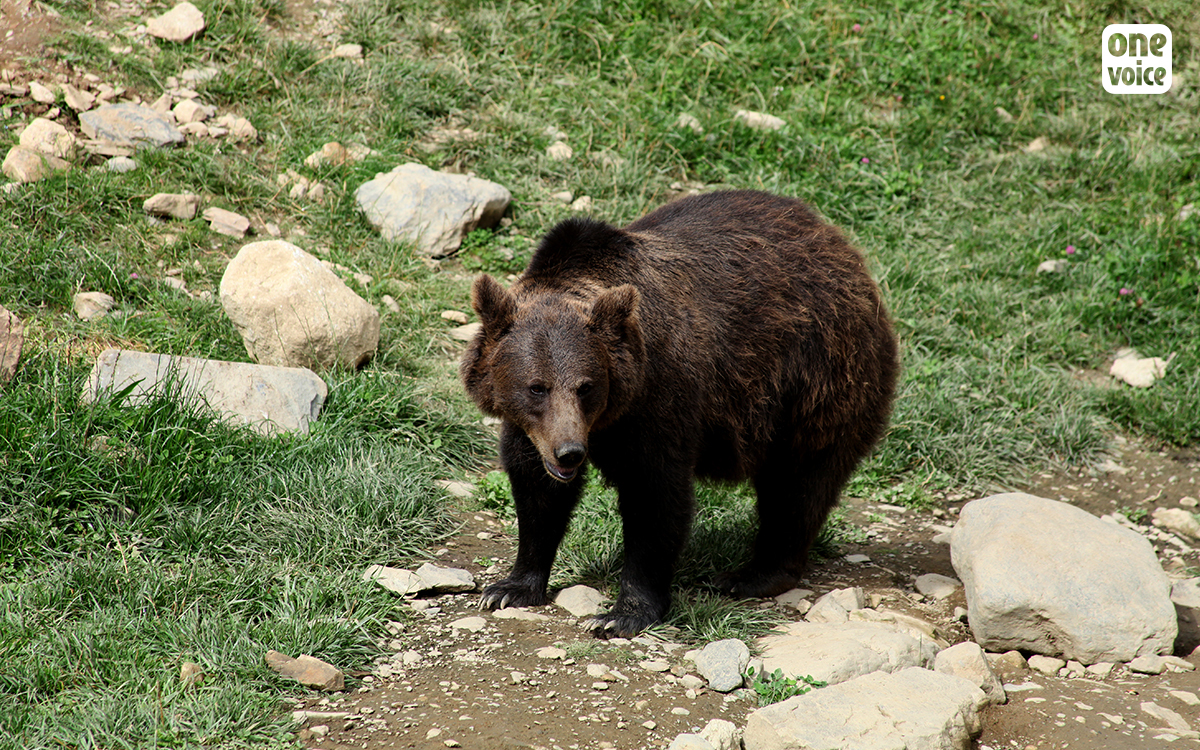
Goiat needs us!
One Voice leads a nonviolent fight to defend animal rights and respect all life forms. The organization operates independently and is thus free to speak and act freely.
Was it really necessary to capture and uproot a free-living bear from Slovenia, where he had all his bearings, where he had grown up and to essentially prevent him from feeding where he was eventually forced to settle? One Voice denounces an inhuman policy towards Goiat and more generally the bears concerned by this type of program. We need all of you to help stop the scaring off of bears!
In the name of biodiversity, an inhuman program for bears
Suspected
of having attacked herds or domestic animals (pigs, sheep or horses)
seven times, the agricultural organizations called for measures
against Goiat, a bear of Slovenian origin who had been “released”
in the Val d’Aran area by Spanish authorities back in 2016. This was
to make up for the lack of genetic diversity in the Pyrenean bear
population, which were the descendants from a single male, the Pyros
bear. The bears do not understand the borders put in place by humans,
Goiat moves between our two countries, followed thanks to the GPS
collar with which he was equipped with.
Goiat
remained the favourite target of the French anti-bear activists. And
this spring, after the attacks of which Goiat is perhaps responsible
for, the Prefect of the Hautes-Pyrénées wishes to put in place
measures of scaring off in order to remove the bear and let us just
say this clearly, try to push it back to the other side of the
border… The “bear plan” also stipulates that in the event of a
so-called “problem bear”, the State can then launch scaring off
operations. But what is a “problem bear”? A bear trying to
feed? And what would be the next step warning shots? The slaughter of
a bear? Isn’t the goal of bringing bears to the Pyrenees to see them
multiply? Along with the inherent risks of their presence?
Let’s take part in a public consultation!
Before
the publication of this decree, the Prefecture must carry out a
public consultation. It will close on June 14th.
In order to prevent this operation of scaring off this bear, many of
us must respond unfavourably to this project.
By
logging on to the site of the Ministry of Ecological and Inclusive Transition, indicate at the beginning of your comment that you are
against the scaring off of Goiat. Then argue your case in a few
lines. Please note, comments that are copied and pasted are not taken
into account. Use your words and phrases without insults or threats
(they would also invalidate your opinion).
To
help you, we offer some key arguments. Choose one or more and develop
them to your liking.
-
The expertise carried out by
the technicians of the National Office of Hunting and Wild Fauna
(ONCFS) has not shown that the bear Goiat is a “problem bear”.
-
Contrary to what is written in
the draft decree, in no case does Goiat behave in a familiar manner.
The attacks attributed to him took place at night, several hundred
meters from homes, in the absence of any human presence. The term
“familiar” is therefore not only abusive, but fallacious.
In the absence of familiar behaviour, it cannot therefore be
categorized as “problem bear” and should therefore not be
frightened.
-
Only the installation of means
of protection of these breeding herds is able to protect the animals
in the long run from attacks from wild predators, but also from stray
dogs which are responsible for much more damage to the herds than any
of these bears, wolves and lynx put together.
-
The farmer who has suffered
two attacks does not have a guard dog for his herd. This deficiency
on his part must in no case be turned against wildlife.
-
The predations that Goiat is
accused of all took place at night. The herds were poorly protected
(lack of electrified fences, ineffective or absent guard dogs, etc.).
-
The installation of electric
fences around bee hives was enough to protect them from Goiat, which
was filmed nearby by an ONCFS hidden camera on 9th
August 2017, demonstrating, if necessary, that simple means of
protection are effective in protecting against the damage caused by a
large predator.
We are counting on you. A big
thank you to everyone.