Evidence about the Link: New initiatives have been born in the United Kingdom
La mission du Links Group est de promouvoir «le bien-être et la sécurité des enfants, des animaux et des adultes vulnérables afin de les protéger contre la violence et la maltraitance».
Since 2001, the National Society for the Prevention of Cruelty to Children (NSPCC) and the Royal Society for the Prevention of Cruelty to Animals (RSPCA) have been working together on the issue of the Link. Together with other organizations pursuing similar objectives, such as the British Veterinary Association (BVA), they form the «Links Group» 1, , which is affiliated with the «National Link Coalition».
«The mission of the Link Groups is to promote the well-being and safety of children, animals and vulnerable adults in order to protect them from violence and abuse.»
The
main results from the Link Groups to date are as follows:
-
More referencing between the
different organisations
-
The first ever law cases won
in non-accidental injury cases for the RSPCA
-
The first ever trial won in a
non-accidental injury case for the Scottish SPCA
-
Undergraduate training in
veterinary medicine
- The addition by the Royal College of Veterinary Surgeons of an appendix
guide to good professional practices concerning the conditions under
which it is possible to derogate from the principles of
confidentiality in certain circumstances.
- Expansion
of services for domestic animals
In
2003, the NSPCC published for the first time a pamphlet for child,
family and animal care professionals, titled “Understanding the
Links (Between) Child Abuse, Animal Abuse and Domestic Violence”².
Written
on the basis from contributions to the international conference on
the relationship between animal abuse and violence against humans
held in 2007 at Keble College, Oxford. Also with the backing of the
Oxford Centre for Animal Ethics, the The Link Between Animal Abuse and Human Violence, which has been published by Andrew Linzey, has
become a reference publication for global research aimed at a better
understanding between the relationship of animal abuse and that of
violence against humans3.
In
2018, new initiatives were launched. The link between animal abuse
and violence against humans is now indisputable, but the application
of this concept in Europe remains practically non-existent. The Royal
Society for the Prevention of Cruelty to Animals (RSPCA) now reports
animal abuse cases when there is a suspicion of associated child
abuse. Of these reports, 86% resulted in the identification of child
protection problems previously overlooked by the authorities.
“Protocols
(formal) using a risk assessment checklist” are emerging, which
could significantly increase the number of reports. Considering that
the RSPCA received 129,000 reports last year, the potential for
discovering “hidden” abuse cases with an optimized
reporting process across England and Wales is considerable. This
initiative has drawn the attention of the College of Policing, whose
assessment of the risk of domestic violence, harassment or
honour-based violence (Domestic Abuse, Stalking and Honour Based
Violence, or DASH) is available to all front-line police officers.
The crime prevention department of the UK National Crime Agency also
expressed interest in this initiative.
Local
adult and child safety boards are now working to provide a more
comprehensive second-level investigation in response to the risk
assessment checklists managed by first responders. This is essential,
given that first responders have limited opportunities to conduct
comprehensive assessments, while these specialist groups have the
necessary authority and competence.
Identification of interhuman violence and mistreatment: Relay procedure between the first two levels of intervention
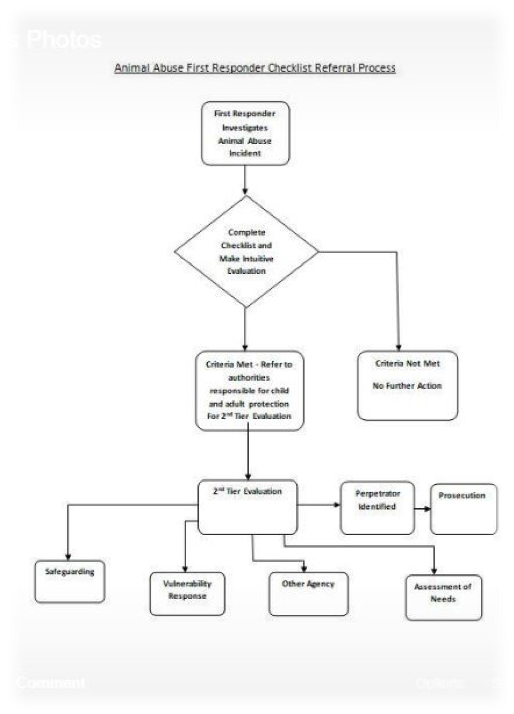
Referral process for the first responder in an animal abuse case
The
first responder investigates a case of animal abuse.
Intuitive
checklist and evaluation.
-
Criteria fulfilled: reporting
to the authorities responsible for the protection of children and
adults for a second level assessment
-
Criteria not met: no
subsequent action
Second
level assessment.
- Guilty
party identified
- Proceedings
- Safeguard
- Response
to vulnerability
Other
organization
Needs
assessment
Sources
1www.thelinksgroup.org.uk
2 www.nspcc.org.uk
3 Brighton, Royaume-Uni, et Portland, États-Unis : Sussex Academic Press, 2009. Publié en France par One Voice en 2012 sous le titre «Violence sur les animaux et les humains… Le Lien